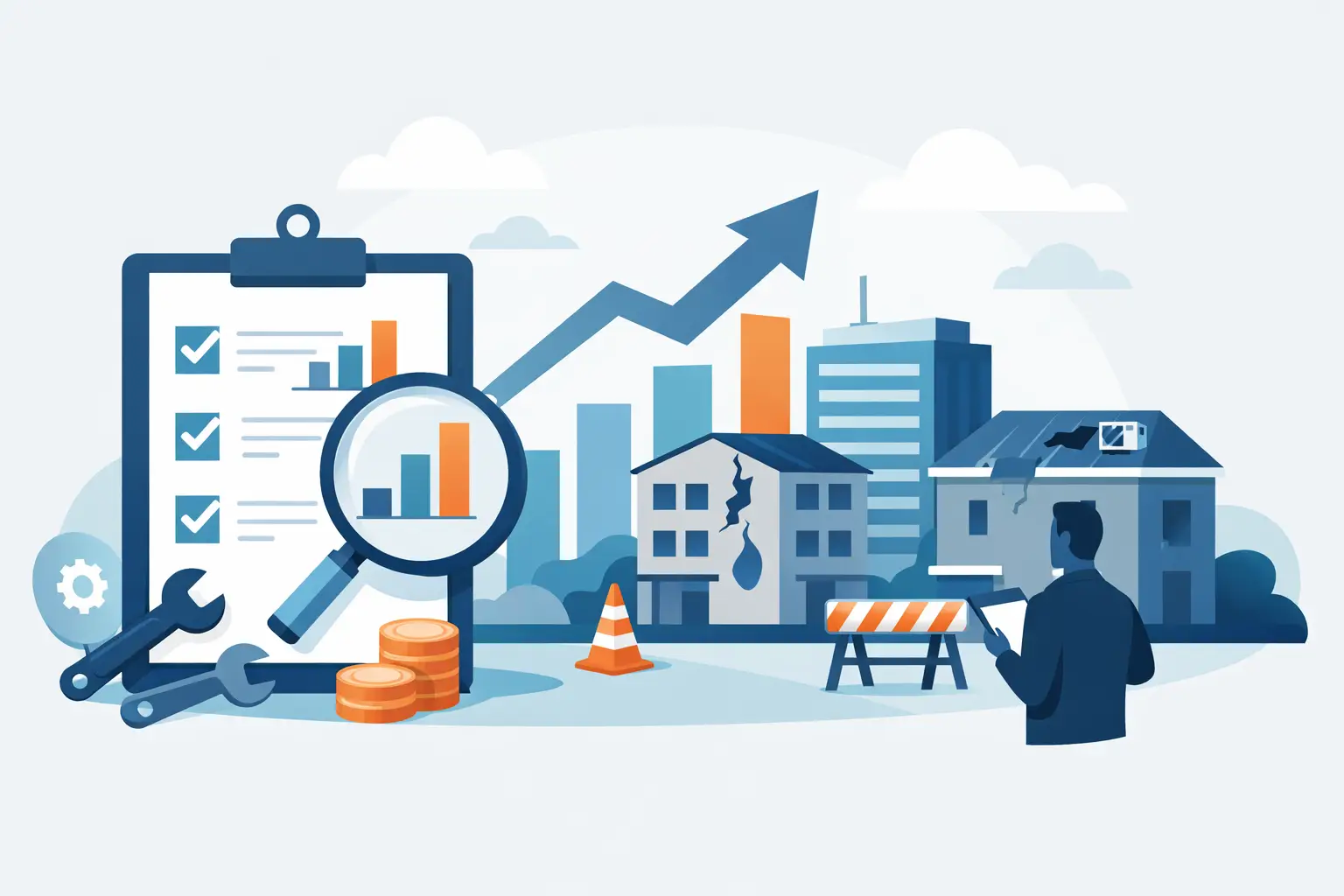
A failed boiler in January, an aging roof before storm season, and recurring elevator shutdowns may all demand attention at once. The challenge is not identifying work that needs to be done. It is deciding what cannot wait, what can be planned, and what produces the strongest long-term result for the property. Knowing how to prioritize capital repairs gives property teams a defensible way to make those decisions without relying on whoever raises the loudest concern.
Capital repair planning is where asset condition, resident experience, financial stewardship, and operational execution meet. When requests, inspection findings, vendor bids, and board approvals live in separate emails and spreadsheets, priorities become unclear and timelines slip. A consistent framework puts every stakeholder on the same page before a manageable repair becomes an expensive emergency.
Start With the Difference Between a Repair and a Capital Decision
Not every costly maintenance issue belongs in a capital plan. Routine work such as a minor plumbing repair, a door adjustment, or a single appliance replacement can often be handled through the operating budget. Capital repairs generally involve a major building component, extend useful life, protect an asset's value, or require significant planning and funding.
Examples include roof replacement, parking lot resurfacing, elevator modernization, HVAC replacement, structural remediation, facade restoration, and major plumbing infrastructure work. The accounting treatment may differ by organization and tax guidance, but operationally, the question is straightforward: does this work materially affect the building's long-term condition, safety, or performance?
Making that distinction early matters because capital work needs a different workflow. It often requires inspections, scopes of work, competitive bids or RFPs, reserve planning, board approvals, resident communication, and project oversight. Treating it like a standard service ticket creates predictable delays.
How to Prioritize Capital Repairs With a Risk-First Framework
The first priority is not necessarily the oldest asset or the largest proposal. It is the work with the greatest combined risk to people, property, compliance, and operations. A practical capital repair framework evaluates each project against the same factors so teams can explain why one project moves ahead of another.
Protect life safety and regulatory compliance first
Any condition that could injure residents, employees, visitors, or vendors belongs at the top of the list. Structural instability, fire and life-safety deficiencies, unsafe electrical systems, gas leaks, failed emergency equipment, and code violations require immediate action or a clearly documented interim mitigation plan.
Compliance risk can be just as urgent even when the defect is not visibly dramatic. Missed inspection requirements, accessibility issues, municipal violations, or expiring certifications can lead to fines, insurance complications, occupancy restrictions, and avoidable exposure. Document the condition, applicable requirement, corrective scope, and deadline in one record. That gives managers and boards a clear basis for approval.
Prevent damage that grows faster than the budget
The next tier includes failures that are likely to cause escalating damage if deferred. A small roof leak can become insulation damage, mold remediation, ceiling repairs, resident claims, and lost rental income. A deteriorating sewer line can progress from scheduled repair to an emergency excavation that disrupts an entire property.
Focus on the cost of waiting, not just the cost of the current quote. Ask what happens if the repair is delayed by three months, six months, or one year. Consider water intrusion, damage to connected systems, business interruption, emergency mobilization premiums, and the possibility that access will become more complicated later.
Measure operational and resident impact
Some capital repairs are not immediate safety events, but they materially affect occupancy, retention, service levels, and the daily workload of the management team. Repeated HVAC failures, unreliable elevators, inadequate drainage, and failing entry systems can generate a high volume of tickets and resident frustration long before complete failure.
Use operating data to identify these patterns. Look at repeat work orders, after-hours calls, vendor spend, downtime, complaint volume, and units affected. An asset that produces recurring maintenance may be consuming more operating budget than a planned capital replacement would require. This is especially relevant across a portfolio, where a recurring issue at several properties may point to a standardized repair or replacement strategy.
Consider asset condition and remaining useful life
Age alone is not a priority score. Two 20-year-old HVAC systems can have very different conditions based on usage, maintenance history, installation quality, and environment. Inspection findings and maintenance records provide a more reliable view than a manufacturer’s expected lifespan alone.
A condition assessment should clarify whether the asset can be repaired, whether repair will meaningfully extend its useful life, and whether replacement is the more economical choice. If a component has reached the end of its useful life but is still operating reliably, the work may be planned rather than rushed. If it is nearing failure and replacement lead times are long, early action may be the lower-risk decision.
Turn Opinions Into a Repeatable Priority Score
A simple scoring model keeps capital planning from becoming a debate driven by incomplete information. Score each project from one to five across safety and compliance, likelihood of failure, consequences of failure, resident or operational impact, cost of deferral, and asset condition. Add a separate factor for funding readiness, such as available reserves, approved financing, or the ability to phase the work.
The score does not replace professional judgment. It creates a consistent starting point and makes assumptions visible. A project with a lower total score may still move ahead if a vendor has a narrow availability window, a seasonal condition affects installation, or a pending sale requires repairs before closing.
Use priority tiers rather than a single ranked list. Immediate work addresses active safety, compliance, or damage risks. Near-term work should be completed within the current planning cycle to avoid escalation. Planned work fits into a one- to three-year capital schedule. Monitor items remain under observation with documented inspection dates and trigger points for action.
Build the Business Case Before Requesting Approval
Boards, owners, and finance teams need more than a proposal total. They need a clear explanation of the problem, alternatives, timing, financial impact, and consequences of deferral. The stronger the project record, the faster stakeholders can approve it.
Each capital request should include inspection photos or reports, a defined scope, bid comparisons, warranty information, expected useful-life impact, schedule, access requirements, and a communication plan for affected residents or tenants. If options exist, show them clearly. For example, compare a targeted repair, a phased replacement, and full replacement with their respective costs, expected lifespan, disruption, and risk.
Lowest bid should not automatically win. A lower initial price can carry more risk if the scope is incomplete, the vendor lacks relevant experience, warranty coverage is limited, or change orders are likely. Compare vendors on scope alignment, insurance, capacity, schedule certainty, communication practices, and documented performance, not price alone.
Centralize the Capital Repair Workflow
Capital work slows down when inspection notes are in one system, bids arrive by email, board questions are handled in text messages, and invoices appear after work is completed. That fragmentation creates missing context and makes it difficult to prove who approved what.
A shared workflow should connect the original condition report to inspections, scopes, vendor bids, approvals, schedules, field updates, invoices, and final closeout documents. Property managers need current status without chasing vendors. Boards need a clear approval trail. Vendors and technicians need accurate scope details and site access information. Portfolio leaders need reporting that shows budget exposure, project status, and recurring asset risks.
This is where an integrated maintenance ecosystem can materially improve execution. ON Property Technologies supports a shared operating environment where stakeholders can coordinate repair activity in real time rather than rebuilding the project history at every handoff. The practical benefit is accountability: fewer lost requests, fewer approval bottlenecks, and a clearer record for the next budget cycle.
Revisit Priorities on a Set Cadence
A capital plan should not be a document that is created during budget season and ignored until the following year. Conditions change. Severe weather accelerates deterioration, vendor lead times shift, reserve balances change, and an asset that was stable can begin generating repeated service calls.
Review high-risk items monthly and the broader capital plan quarterly. Update project scores after inspections, major repairs, new bids, or changes in occupancy and funding. Keep deferred projects visible with a stated reason for deferral and a next review date. That documentation protects the organization from accidental neglect and gives incoming managers or board members the context they need.
The best capital repair decisions are rarely the ones made fastest. They are the ones supported by current condition data, clear risk analysis, complete vendor information, and a workflow that lets every stakeholder act with confidence when the timing matters.